Field note #3: At work, ancestral intelligence is a double-edged sword
What happens when the very intelligence that could help you is the thing you put down?
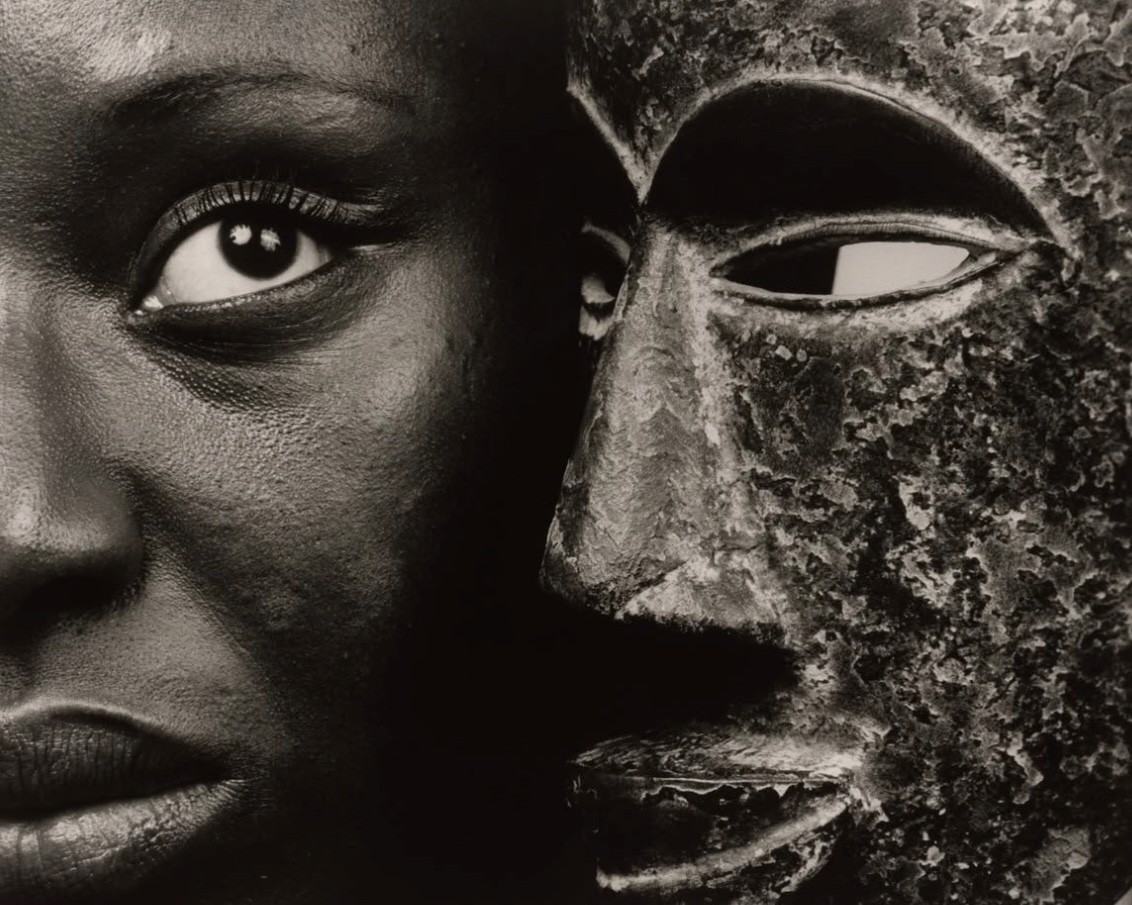
Angèle Etoundi Essamba, Héritage 2 from the series *Masks*, 1999
Essays
A note from the field: There is intelligence you carry that has no name in your workplace.
I once worked at an organisation in the UK — a fast-growing scale-up working with governments around the world. They described themselves as politically neutral. I wanted to believe that framing. I had accepted the role, I bought into the mission statement, and I wanted to do good work.
But things registered with me. Small things first, then less small.
The company hired South Africans — but, at the time, there were only white South Africans. I was the only Black woman, one of three Black people in the company. When a new political administration arrived and the cultural winds shifted, certain stances — the ones that gestured toward equity — were quietly rolled back. There were different standards for different countries, and a felt culture of silence around anything that might disturb the surface.
My body knew before my mind was willing to concede. Not alarm bells exactly… More like a low, steady hum of recognition. I could feel my own history pressing against the walls of the role. The lessons I had learned growing up in South Africa. The patterns I had studied. The experiences that had shaped what I understood about power, belonging, and who gets to be visible. All of it was available to me. All of it was relevant.
And I actively worked to silence it.
Not because I didn’t trust what I knew. But because the environment made that knowing expensive. There was no language for it, no space for it, no incentive to surface it. So I negotiated with myself. I muted the very intelligence that could have oriented me more honestly, and I was aware of doing it the entire time.
That’s what I want to talk about.
Symbolic memory and the intelligence that precedes you
Black leaders, professionals and creators carry symbolic memory into their work whether they name it or not.
By symbolic memory, I mean the inherited meaning systems, cultural ways of knowing, spiritual orientations, and ancestral intelligence that live in how we make decisions, interpret situations, relate to authority, understand sacrifice, and define what success actually means. It is the intelligence that preceded you. The knowing that arrived before your career did.
The developmental question is not whether this material is present. It is. The question is how you relate to it.
And here, I see a polarity that rarely gets named clearly enough.
On one end: disconnection. The pressure to operate as though your symbolic origins do not exist.
To be “professional.”
To be “rational.”
To leave that stuff at the door.
This is not always a conscious choice. Often, it is produced by the environment — urgency cultures, scarcity logics, performance demands. And frankly, racism and discrimination. These conditions shape your cognition while remaining opaque, unnamed, and difficult to contest. You stop accessing your deeper knowing not because you have rejected it, but because the architecture around you has made it functionally unavailable.
On the other end: over-identification.
Here, symbolic memory becomes so sacralised that it cannot be questioned, updated, or held with discernment. Every decision becomes ancestral mandate. Every instinct is elevated to spiritual authority. The symbols become totalising. Not a living inheritance you are in dialogue with, but a fixed script running you from underneath, now with a narrative of empowerment attached.
This end of the spectrum is less discussed. But it matters. Not all symbolic memory is applicable to every situation. Some inherited scripts — about sacrifice, about what leadership must cost, about who deserves rest, about how money should be held — may have been survival-wise in one context and quietly constraining in another.
Ancestral intelligence is not infallible. It is an inheritance. And like all inheritances, it requires discernment about what to carry forward and what to lovingly release.
What both ends share: in neither case are you in conscious relationship with your symbolic memory. At one end, it is invisible. At the other, it is untouchable.
Either way, it is running you.
The sword and how to hold it
You cannot set this sword down. Symbolic memory is operative in your work whether you have language for it or not. The question is never whether it influences your decisions. It is whether you are in a position to notice, engage, and sometimes lovingly challenge that influence.
I think about Beatrix Dixon, an African-American and the founder of The Honey Pot Company. She turned down a $450 million buyout offer.
In interviews, she has spoken about how the company was gifted to her by her ancestors — that its origin was not simply entrepreneurial but spiritual. And so money alone could not determine the decision. Not just anyone could buy it.
What strikes me about this is not the mysticism. It is the architecture of the decision.
Dixon was in active, conscious relationship with her symbolic memory. She allowed ancestral intelligence to sit at the decision-making table alongside market logic, financial pressure, and strategic calculation. And that meant the decision became more complex, not less. It meant holding something that most business frameworks have no container for. It cost something real to honour that knowing.
This is the double edge.
When you actually listen to ancestral intelligence, it can demand things that the market, the boardroom, the investor, or the institution will not reward. The sword cuts because the intelligence is real, and being faithful to it sometimes puts you at odds with every logic that surrounds you.
And yet the alternative is worse. Disconnection from symbolic memory does not make you free. It makes you available to be shaped by whatever forces fill the vacuum — institutional norms you did not choose, success metrics that have nothing to do with your actual flourishing.
What’s at stake
Don’t think that the only symbolic memory you need to reckon with is your own. It is not.
Every organisation, every institution, every culture is running on inherited sense-making that often goes unexamined. The company I described earlier was not acting in bad faith. They were operating from their own logic one that made sense within their frame. Their decisions about hiring, about what to roll back and when, about which topics warranted silence. These were coherent with an inherited way of reading the world: what counts as risk, what counts as neutrality, who counts as a natural fit. That logic has its own ancestry, its own symbolic memory, even if they would never use those words.
Here is the real risk:
If you have not learned to surface your own inherited logics — to hold them as object, to examine them with discernment — you will not only be subject to your own unexamined scripts. You will be subject to everyone else’s. You will sit inside systems running on logics you can feel but cannot name, operating from inheritances you can sense but cannot contest. Not because you lack the intelligence to see it. But because you never developed the practice of seeing your own.
The capacity to read the operative logic of any room, institution, or system — to ask whose inheritance it reflects and what yours tells you about the gap — begins with the willingness to do that work on yourself first.
That is not a luxury. For Black professionals navigating spaces built on logics that were not authored with them in mind, it is a necessity.
The developmental move is neither disconnection nor over-identification. It is relationship. The capacity to hold your symbolic inheritance as something you can see and be in conscious dialogue with it.
Unfortunately, much of what passes for engagement with symbolic memory stays at the level of selection — curating which traditions to keep, which symbols to display, which narratives to claim. But the deeper work is integration. Allowing your encounter and conscious engagement with inherited wisdom to genuinely reorganise what is possible for you. Not just filtering the inheritance, but being transformed by the engagement with it. Such that you, and what you can build, are different afterward.
If the move is conscious relationship with your symbolic inheritance, what does that actually require?
In our work at Ijeruka, we return to three pillars:
Character — The clarity to know what is actually non-negotiable for you, and the discernment to revisit those non-negotiables as your perspective expands.
Dixon’s decision required character. She had to know, under real financial pressure, what she was unwilling to compromise. But character is not rigidity or moral posturing. It is the willingness to hold your convictions and still ask whether they belong to you or to an inherited script you have never examined.
Capacity — the ability to hold complexity without fragmenting. To metabolise contradiction, absorb visibility, and stay regulated when the stakes rise. This is what the disconnection-over-identification polarity actually demands of you.
Coherence — alignment between what you say matters and how you actually move in the world. How do you make decisions when incentives pull elsewhere? Can you navigate power spaces without splitting yourself?
From these three pillars, something deeper emerges: cultural and systemic awareness: the ability to see how values become norms, how norms shape incentives, how incentives shape behaviour, and how all of this shapes the systems you move within.
You stop being a passive carrier of culture and become a deliberate navigator. Your ambition becomes rooted in clarity about what you are actually building, for whom, and why.
That is what it looks like to hold the sword with both hands.
Let’s Turn the Lens on You
Over the next few days, sit with these questions. Not to answer them neatly, but to notice what they stir.
Where in your work do you carry knowing that you’ve learned to mute? What would it cost to let it speak?
Is there an inherited narrative — about sacrifice, about success, about what your work must mean — that you’ve treated as beyond question? What happens if you hold it with tenderness and curiosity?
What are the conditions in your environment that make it harder to stay in relationship with your deeper knowing? Are those conditions ones you can redesign — or do you need to build a different container?